 By Sofia Bennett, Home & Decor Editor
Reviewed & updated September 2026
A nightstand is the smallest surface in the bedroom, yet it's the one you actually touch every single day — reaching for a lamp switch, a glass of water, a phone charger. Style it wrong and it becomes a landing pad for clutter within a week; style it right and it does double duty as a functional bedside station and a genuinely finished piece of decor. Here are five layouts that actually hold up in daily use.
 Quick navigationCurated by Sofia · 10 min read
- The rule of odds (and why balance still matters)
- Layout 1: Lamp, book stack, and tray
- Layout 2: The minimalist edit
- Layout 3: Storage-first for small rooms
- Layout 4: Plant and candle for texture
- Layout 5: The small-space stack
- What to avoid
- Choosing a nightstand lamp
- Adding personality and texture
- Budget vs. splurge options
- Small-space nightstand alternatives
- The takeaway
- Further reading & trusted sources
The rule of odds (and why balance still matters)
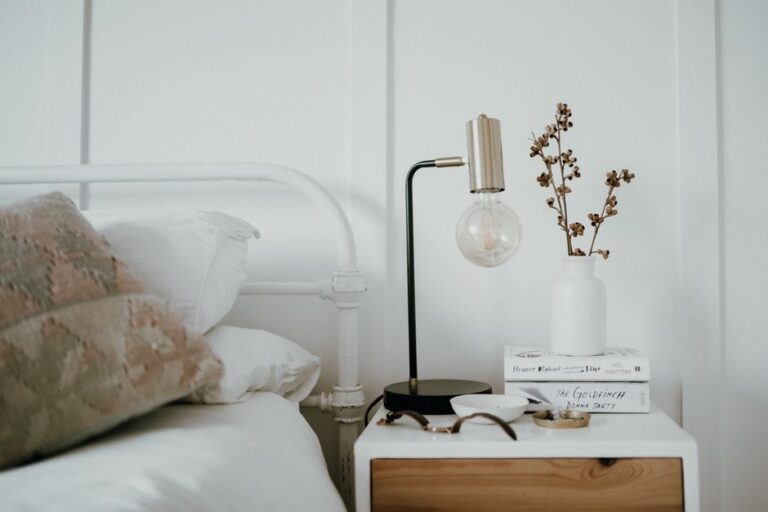
Interior stylists lean on odd numbers — one, three, or five objects — because odd groupings photograph and read as more natural than even ones. An even number of items tends to split visually into pairs that compete for attention, while an odd group has a natural focal point with smaller pieces supporting it. On a nightstand this usually plays out as one tall item (a lamp), one medium item (a stack of books or a small vase), and one small item (a candle, a trinket dish, or a piece of jewelry left out overnight).
Balance is the other half of the equation. "Balance" doesn't mean symmetry — it means the visual weight is distributed so the surface doesn't feel top-heavy on one side. A tall lamp on the back-left corner wants a lower, horizontal element (a stack of books, a low bowl) somewhere else on the surface to keep your eye from snapping straight to one spot.
Layout 1: Lamp, book stack, and tray
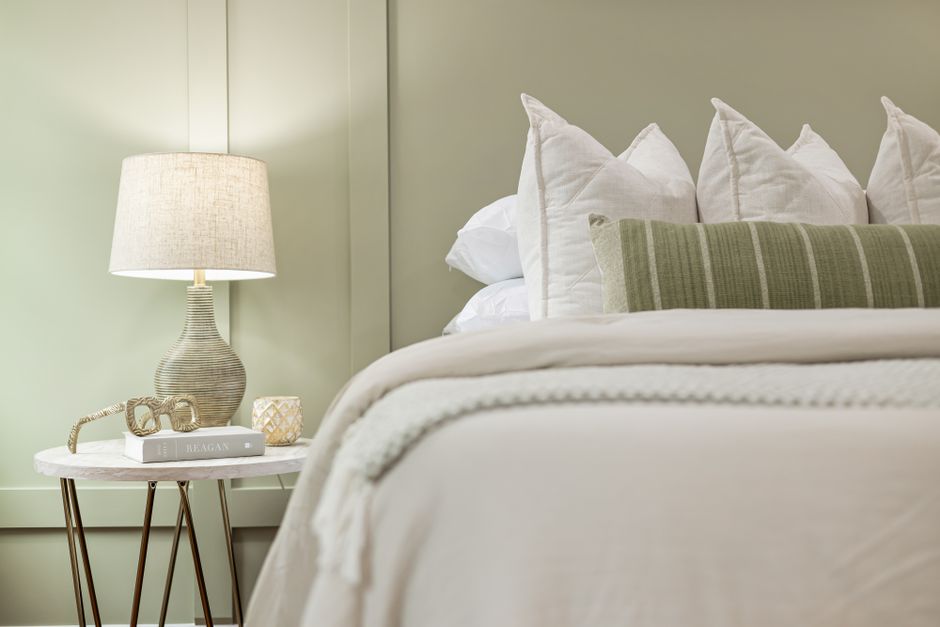
This is the most reliable formula because it's built entirely around things you actually use. Start with a lamp in the back corner nearest the wall outlet. Add a small stack of two or three books — angle the top one slightly, or lay it flat with a small object like a candle or a pair of glasses resting on top. Then set everything functional (phone, water glass, hand cream) onto a small tray, roughly 6-9 inches across. The tray is doing more work than any single object on the nightstand: it visually corrals the practical clutter into one intentional-looking zone instead of letting it scatter across the surface.
Layout 2: The minimalist edit
If you want a calmer, hotel-adjacent look, cut the count down to two or three objects total: a lamp, one small plant or a single stem in a bud vase, and nothing else. The trick to making minimalism read as intentional rather than empty is leaving genuine negative space — at least half the surface should be visibly clear. This layout works best on a smaller nightstand where a fuller arrangement would look cramped, and it's the easiest to keep tidy long-term because there's simply less to accumulate around.
Layout 3: Storage-first for small rooms
When floor space is tight, the nightstand itself needs to work harder, so the styling follows the function. Choose a piece with at least one drawer or a lower shelf, and keep the top surface to just a lamp and one small catch-all dish for things you'd otherwise pile loosely — rings, hair ties, a charging cable. Everything else (extra books, tissues, chargers) goes inside the drawer or on the lower shelf in a small basket. The visible surface stays close to the minimalist layout above, but the storage underneath is what actually prevents clutter from creeping back onto the top within a few days.
Layout 4: Plant and candle for texture
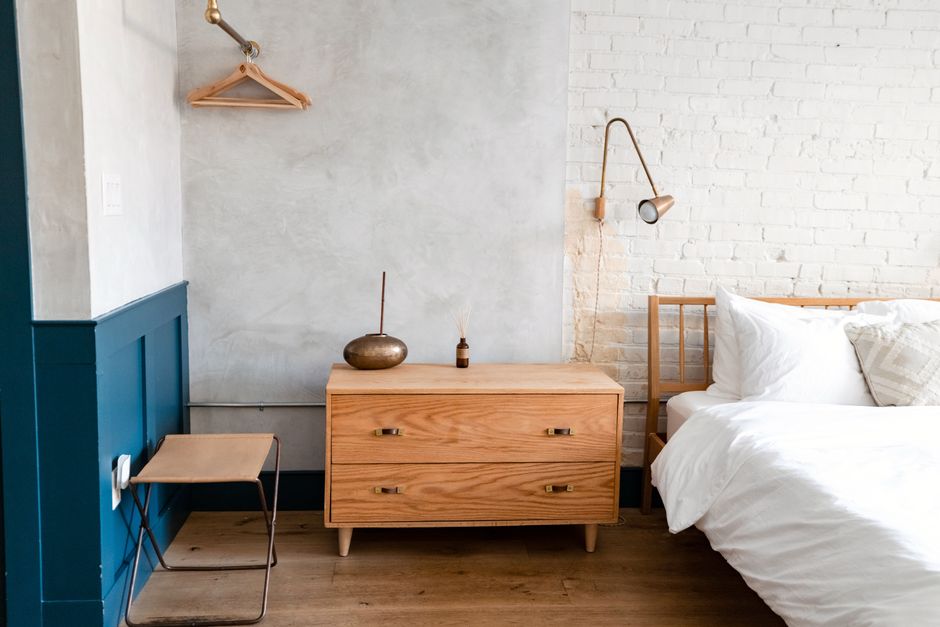
Swap the book stack for something living and something flickering. A small potted plant (pothos, snake plant, or a faux version if your bedroom gets little light) adds organic texture that photographs and lives differently than a stack of hardcovers, while a candle in a low, wide vessel adds warmth without taking up much footprint. This layout pairs especially well with a shorter or unconventional lamp, since the plant naturally takes over some of the vertical visual weight.
Layout 5: The small-space stack
If there's no room for a traditional nightstand at all — common in studio apartments or a bed pushed into a corner — a wall-mounted floating shelf, a slim stool, or even a stack of two vintage suitcases can substitute. Style it exactly like layout 2 (lamp plus one or two small items), but pay extra attention to keeping the lamp cord tidy, since a shelf or stool has no drawer to hide it in. A small cord clip run along the wall behind the headboard keeps this layout from looking improvised.
What to avoid
Two mistakes show up more than any others. The first is a lamp that's too tall relative to the bed — as a rule of thumb, the bottom of the lampshade should sit roughly at eye level when you're sitting up in bed, which usually means the whole lamp (base plus shade) lands somewhere around 24-30 inches for a standard-height nightstand. A lamp that towers well above the headboard throws off the entire proportion of the bedside grouping. The second mistake is letting the surface become a default catch-all — once a phone charger, a stray earring, and a half-empty water glass accumulate, everything else you've styled gets visually swallowed by the mess. A tray (layout 1) or a drawer (layout 3) solves this structurally rather than relying on willpower to keep the surface clear.
Choosing a nightstand lamp
The lamp is almost always the anchor of the whole arrangement, so it's worth prioritizing over the smaller accessories. Look for a warm-white bulb (2700K) rather than a cool or daylight bulb — the difference in how "cozy" a bedroom feels at night from bulb color alone is larger than most people expect. A lampshade in a soft fabric (linen, cotton) diffuses light more gently than a hard plastic or metal shade, which matters more in a bedroom than almost any other room since it's usually the last light on before sleep. If you read in bed, prioritize a shade that directs light downward and outward rather than straight up, and consider a lamp with a built-in dimmer or use a smart bulb you can dim from your phone.
Adding personality and texture
A nightstand styled purely by formula can still feel generic if every object is brand new and matched. The layouts above work as a skeleton — the personality comes from what you actually put in each slot. Swap the generic ceramic tray for a piece of pottery you picked up while traveling, use a book you're genuinely rereading instead of a decorative hardcover bought for its spine color, or let a slightly mismatched vintage lamp be the one imperfect element in an otherwise coordinated bedroom. Mixing at least one worn or personal object into an otherwise polished arrangement is usually what separates a room that feels styled from one that feels lived-in — both are valid, but most people are actually chasing the second.
Budget vs. splurge options
You don't need to spend on all five elements of a nightstand vignette at once. A lamp is the one piece worth spending more on if your budget is limited, since it's used daily and its light quality is felt every night — a $40-60 lamp with a decent shade will outperform a $15 lamp with a bulb visible through thin fabric. Trays, books, and small dishes are the easiest place to save; thrifted trays and library sale books cost next to nothing and add more character than new ones from a big-box store. Save splurge budget for the lamp and, if you want one, a single well-made ceramic or glass vessel for flowers or a candle — a piece with some weight to it reads noticeably more expensive than a lightweight plastic equivalent, even at a similar price point.
Small-space nightstand alternatives
Not every bed has room for a full nightstand, and that's fine — the function matters more than the furniture category. A floating shelf mounted at nightstand height keeps the floor clear in a tight room and can hold a small lamp plus one or two objects. A slim bar cart or narrow rolling table works if you need something that can be pulled closer to the bed and pushed away during the day. Even a stack of two sturdy boxes or vintage suitcases, topped with a small tray, gives you a surface for a lamp and a glass of water without committing to a piece of furniture at all. The five layouts above scale down to any of these alternatives — what matters is the lamp, the balance of objects, and keeping the surface from becoming a dumping ground.
The takeaway
A well-styled nightstand comes down to three things: a lamp sized and positioned correctly for the bed, an odd-numbered grouping of objects with a mix of heights, and a system (a tray or a drawer) that keeps daily clutter from taking over the surface. Pick the layout that matches your space and how you actually use the nightstand — a reader wants a book stack and good task lighting, a minimalist wants negative space, and a small room benefits most from hidden storage doing the heavy lifting. None of these layouts require new furniture to try; most can be assembled from what's already in the house plus one trip to swap a bulb.
Frequently asked questions
How many items should be on a nightstand?
Three to five objects is the sweet spot for most nightstands — enough to feel intentional and functional without tipping into clutter. Smaller surfaces (under 16 inches wide) look better with the lower end of that range, closer to two or three.
What height should a nightstand lamp be?
As a general guide, the bottom of the lampshade should sit roughly at eye level when you're sitting upright in bed. For a standard-height nightstand, that usually puts the full lamp (base and shade) somewhere around 24-30 inches tall, though it varies with your bed and mattress height.
Do both nightstands need to match?
No — matching nightstands create a symmetrical, coordinated look, but intentionally mismatched nightstands (different heights, materials, or shapes) can look equally styled if you keep a shared element, like the same lamp style or a consistent color palette, tying the two sides together.
What's the biggest mistake people make styling a nightstand?
Letting the surface become a catch-all for daily items with no system — chargers, jewelry, and loose papers accumulate fastest when there's no tray, dish, or drawer designated to hold them, and that clutter undoes any styling within days.
Read next
The detail most people miss
The single detail that predicts whether a nightstand stays tidy is the presence of a small tray or dish, not the styling on top of it — surfaces with a designated catch-all for daily items (charger, jewelry, glasses) stay clear for months, while surfaces without one accumulate clutter within days regardless of how carefully they were arranged. Lamp height relative to the mattress matters more than most people budget for; a lamp sized for a floor reading chair often towers awkwardly over a bed once the mattress and bedding add several inches of height.
Further reading & trusted sources
Sofia is happiest hunting down the high-end look for a fraction of the price; she’s convinced a beautiful room comes from restraint and clever styling far more than from budget. She shapes Dreamy Dwell’s room-by-room guides around ideas you can actually copy in a rental or on a tight budget — no staged ‘this is my mansion’ fantasy. AI tools help with the research and first drafts, and a human edits every piece before it goes live. We never fake reviews or pass off a styled photo as a real before-and-after.