 By Sofia Bennett, Home & Decor Editor
Reviewed & updated September 2026
Most linen closets don't fall apart because of bad products — they fall apart because everything gets crammed in without a system, so the first person in a hurry just shoves a towel wherever it fits. A closet that stays organized needs a layout that's actually easier to maintain than to mess up.
 On this pageCurated by Sofia · 7 min read
- Start by taking everything out
- Group by category, not by “which shelf has room”
- The trick that actually keeps sheet sets from becoming a tangled pile
- Use labeled bins for anything smaller than a stack of towels
- Fold towels so shelves show contents, not just fabric
- Keep a working inventory in your head with the “one in, one out” rule
- What to avoid
- The takeaway
- Further reading & trusted sources
Start by taking everything out
It's tempting to organize around what's already sitting on the shelves, but that usually just reorganizes clutter instead of removing it. Pull everything out onto a bed or the floor so you can actually see the full volume of what you own — this alone reveals things people forget they have two or three of.
While it's all out, sort into three honest piles:
- Keep — used within the last year, in good condition
- Donate — good condition but unused (extra sheet sets, gifted towels never opened)
- Toss — stained, thin, torn, or the mismatched half of a set
Most linen closets are 20-30% overstuffed with things in the donate or toss pile. Removing that volume first makes every organizing method below actually work, instead of fighting for space against things you don't need.
Group by category, not by "which shelf has room"
The single biggest reason linen closets get messy again fast is items scattered across multiple shelves by whatever fit at the time, instead of grouped logically. Pick zones and stick to them:
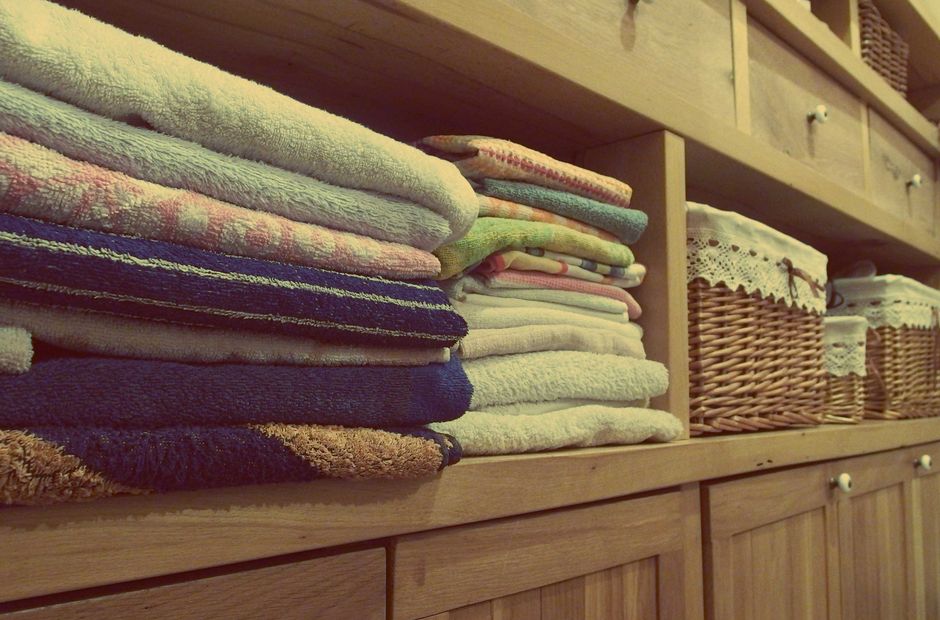
- Bath towels and hand towels — usually the bulkiest category, deserves the most accessible middle shelves
- Bed linens — sheets, pillowcases, duvet covers, grouped by size (twin, full, queen, king)
- Extra blankets and throws
- Off-season or guest-only items — holiday linens, guest towels, extra guest sheets
- First aid, medicine, or overflow toiletries, if the closet doubles as storage for these
[TAKE]Put the categories you reach for weekly (bath towels, everyday sheets) at eye level or waist height. Reserve the highest and lowest shelves for things you touch once a season — guest linens, holiday items, off-season blankets.
The trick that actually keeps sheet sets from becoming a tangled pile
Loose folded sheets are the single most common linen closet failure point — a fitted sheet, flat sheet, and two pillowcases folded separately always end up as four items sliding around independently, and within weeks it's a jumbled pile. The fix that actually holds up: fold one complete sheet set inside one of its own pillowcases.
- Fold the fitted sheet, flat sheet, and remaining pillowcase into a neat stack.
- Slide the whole stack into the spare pillowcase like an envelope.
- Fold the pillowcase over once to close it.
Now every sheet set is a single, self-contained unit that stays together no matter how it gets pulled out or put back — and you can tell what size it is at a glance if you label the pillowcase itself.

Use labeled bins for anything smaller than a stack of towels
Anything that isn't a foldable flat item — heating pads, extra pillow protectors, travel-size toiletries, sewing kit, spare lightbulbs if they've ended up in there — turns into loose clutter fast unless it's contained. A few labeled bins or baskets per shelf keep small items from drifting into the gaps between towel stacks, and make it obvious at a glance where something belongs when it's time to put it back.
Clear bins work well because you can identify contents without opening them; woven or fabric bins work well if you'd rather not see the contents but still want the containment.
Fold towels so shelves show contents, not just fabric
Two folding methods solve two different closet problems:
- Flat, stacked folds — the traditional method, best for deep shelves where you're not trying to see everything at once. Keep stack height to 6-8 towels max; taller stacks topple and get pulled apart searching for one from the middle.
- Rolled towels, stood on end — better for narrower or shallower shelves, and lets you see and grab a single towel without disturbing the rest of the stack, similar to how retail stores display them.
If your household regularly digs through a stack looking for a specific towel, switching that shelf to rolled storage solves the problem structurally instead of just re-folding it neater.
Keep a working inventory in your head with the "one in, one out" rule
Linen closets creep back into clutter mainly through slow accumulation — a new towel set bought on sale, a gifted throw blanket, hotel-quality pillowcases from a trip. None of these feels like "too much" individually, but they compound over a year or two.
A simple rule prevents this without requiring constant reorganizing: when something new comes in, something old and worn goes out. This keeps the total volume roughly constant and means you're never doing a full from-scratch purge again — just small, ongoing maintenance.
What to avoid
- Vacuum-sealing everyday linens — it saves space but adds friction every single time you need something, which means people start avoiding the closet and leaving things out instead. Save vacuum bags for genuinely seasonal items you access once or twice a year.
- Over-stacking narrow shelves — tall, unstable stacks on narrow shelving are what usually causes the "grab one item, everything topples" problem that makes people give up on staying organized.
- Skipping labels because "I'll remember" — labels aren't really for you on day one, they're for whoever else uses the closet, and for you six months from now when the system has faded from memory.

The takeaway
A linen closet stays organized when the system is easier to maintain than to ignore — clear categories, sheet sets bundled as single units, labeled bins for loose items, and a one-in-one-out habit to stop slow creep. The upfront sort-and-purge step matters more than any storage product, since no bin or shelf divider fixes a closet that's simply overstuffed with things nobody uses.
Frequently asked questions
How often should I redo my linen closet organization?
A full sort-and-purge once a year is enough for most households if you're following the one-in-one-out rule in between. Without that habit, expect to redo it every 4-6 months as accumulation creeps back in.
What's the best way to store extra pillows?
Compress them slightly in breathable cotton storage bags rather than airtight plastic, which can trap moisture and cause a musty smell over time. Keep them on a higher shelf since they're usually accessed only occasionally.
Should towels be folded in thirds or in half?
For standard bath towels, folding lengthwise in thirds then in half (rather than just in half twice) creates a neater, more uniform rectangle that stacks more evenly and looks tidier on open shelving.
How do I stop other people in my house from messing up the system?
Label every shelf and bin clearly, and keep the system simple enough that putting something back correctly takes the same effort as putting it back wrong. Complicated systems with too many subcategories are the ones that get abandoned first by everyone except the person who built them.
Read next




Further reading & trusted sources
Worth knowing before you start
The top shelf above eye level is almost always the most underused space in a linen closet, since reaching up feels inconvenient — but that friction is exactly why it’s the right spot for off-season items you only need a couple of times a year. Bundling each sheet set inside its own matching pillowcase solves the tangled-pile problem structurally, instead of just re-folding the same loose stack neater each time it collapses.
Sofia is happiest hunting down the high-end look for a fraction of the price; she’s convinced a beautiful room comes from restraint and clever styling far more than from budget. She shapes Dreamy Dwell’s room-by-room guides around ideas you can actually copy in a rental or on a tight budget — no staged ‘this is my mansion’ fantasy. AI tools help with the research and first drafts, and a human edits every piece before it goes live. We never fake reviews or pass off a styled photo as a real before-and-after.