 By Sofia Bennett, Home & Decor Editor
Reviewed & updated September 2026
A fireplace mantel is one of the few spots in a home that's basically a built-in display shelf, yet it's easy to let it sit bare eleven months out of the year and only decorate it for the holidays. A well-styled mantel can anchor an entire living room, whether the fireplace is a working feature or a decorative focal point.
 What you’ll find insideCurated by Sofia · 6 min read
- Start with the anchor piece
- Build in layers, not a straight line
- Play with height and asymmetry
- Bring in texture and greenery
- Don’t ignore what’s below and around it
- Seasonal swaps without a full redo
- Working with a non-functional or faux fireplace
- Common mantel styling mistakes
- The takeaway
- Further reading & trusted sources
Start with the anchor piece
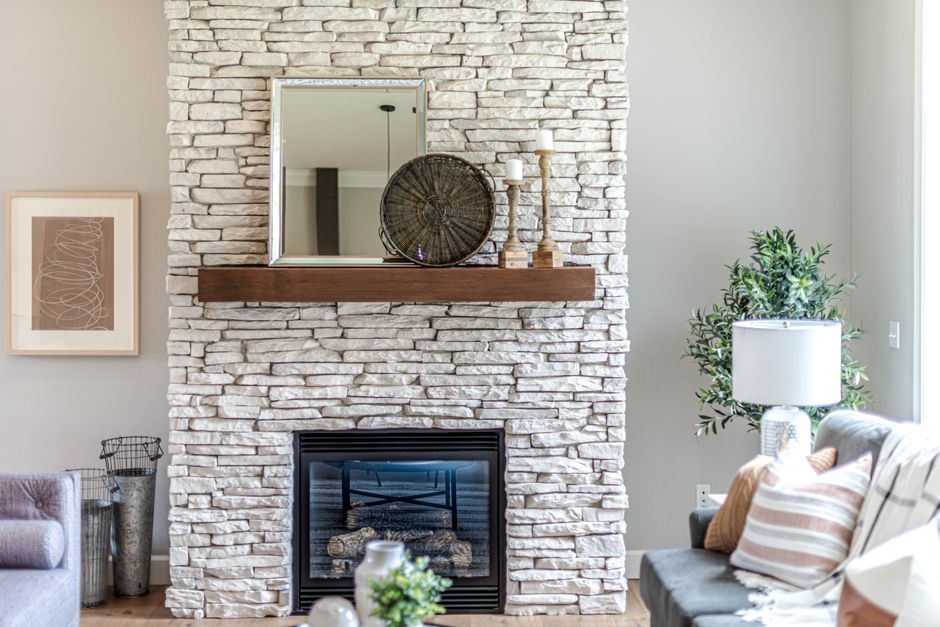
Every good mantel starts with one dominant item that sets the scale for everything else. A large leaning mirror is the classic choice because it adds depth and bounces light around the room, but an oversized piece of art, a gallery-style cluster of smaller frames, or even a statement clock all work as anchors. The anchor should be tall enough to fill roughly two-thirds of the width of the mantel and sit with its base resting directly on the surface rather than floating in the middle of empty space above it.
Build in layers, not a straight line
Instead of lining objects up shoulder-to-shoulder like a shelf display, think in overlapping layers front-to-back. Place your anchor piece against the wall first, then add a medium-height item (a vase, a stack of books, a small sculpture) slightly in front and to one side, and finish with one or two small objects in front of that. This layering creates visual depth so the mantel reads as styled rather than just "stuff set out."
Play with height and asymmetry
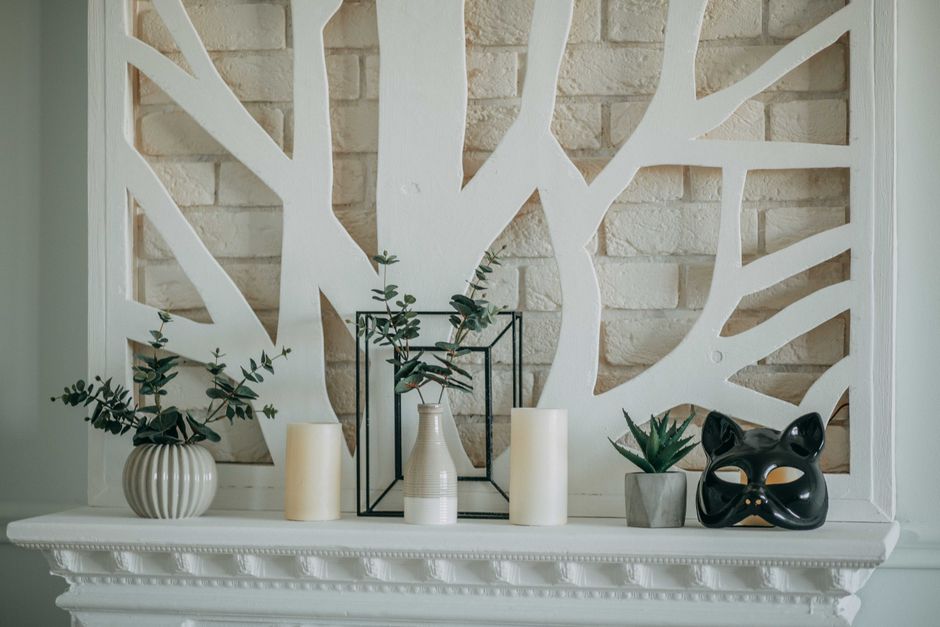
A common mistake is centering everything perfectly and matching heights on both sides, which tends to look stiff rather than intentional. Try an asymmetrical arrangement instead: a taller grouping on one side balanced by a shorter, wider grouping on the other. Odd-numbered groupings (three candlesticks, three books, three small vases) generally look more natural than pairs.
Bring in texture and greenery
A mantel full of hard, glossy surfaces (glass, metal, ceramic) can start to feel cold. Balance it out with something organic — a trailing vine of faux eucalyptus, a low bowl of dried pampas grass, a rustic wood tray, or a woven basket tucked to one side. Even a single stem in a bud vase softens an otherwise formal arrangement and keeps it from feeling like a showroom display.
Don't ignore what's below and around it
The area directly beneath the mantel matters just as much as the surface itself. A pair of oversized floor vases, stacked firewood in a log holder (even decorative, unused firewood), or a low bench flanking the fireplace all extend the styling downward instead of leaving a dead zone. If there's a hearth ledge, a few candle lanterns or a small potted plant can fill it without crowding the actual fireplace opening.
Seasonal swaps without a full redo
The easiest way to keep a mantel feeling current without restyling it from scratch every few weeks is to keep your anchor and base layer permanent, and only swap the small, front-layer accents seasonally. A vase that holds fresh flowers in spring can hold dried wheat stems in fall and a few ornaments in winter, without touching anything else on the mantel. This gives you seasonal variety with a fraction of the effort of a full changeover.
Working with a non-functional or faux fireplace
Many homes today have a fireplace that's purely decorative, and that actually opens up more styling freedom since you don't need to leave clearance for heat or flames. Some people place a stack of oversized books, a large lantern, or even a folded blanket ladder directly inside the firebox opening itself, which fills what would otherwise be an awkward dark gap when it's not visible from a normal sightline.
Common mantel styling mistakes
- Too many small items with no anchor. Without one dominant piece, a mantel full of trinkets reads as clutter instead of a curated display.
- Everything the same height. Flat, uniform heights make the eye skip right over the mantel instead of pausing on it.
- Overcrowding the whole surface. Leaving some visible negative space, especially around the anchor piece, is what makes the arrangement feel intentional rather than crammed.
- Ignoring scale relative to the wall. A tiny mirror above a large fireplace looks lost; the mantel decor should feel proportional to the wall space around it.
The takeaway
A great mantel comes down to picking one strong anchor, layering a few supporting pieces at varied heights in front of it, and leaving enough breathing room that nothing feels crowded. Keep the big pieces semi-permanent and rotate only the small accents seasonally, and you'll have a mantel that looks intentional year-round instead of only during the holidays.
Frequently asked questions
What size mirror should I put over a mantel?
As a general guide, aim for a mirror that's about two-thirds the width of the mantel and hung with its bottom edge 4-8 inches above the mantel surface, so it feels connected to the fireplace rather than floating on the wall.
How do I style a mantel if I don't have a big budget?
Lean on what you already own — books stacked at different heights, a favorite vase, a candle you already have — and add one inexpensive new piece like a small mirror or a bundle of dried grass from a craft or grocery store to tie it together.
Should mantel decor match the rest of the room exactly?
It should coordinate, not match exactly. Pulling one or two colors or materials already present elsewhere in the room (like a wood tone or an accent color) ties the mantel in without making it look like a matched set.
How often should I restyle a fireplace mantel?
There's no fixed rule, but many people refresh the small front-layer accents every season and leave the larger anchor pieces in place for a year or more, which balances variety with not having to restart from scratch constantly.
Read next

Further reading & trusted sources
The detail most people miss
A mantel arrangement with every object at the same height is the single most common reason a styled mantel still reads as flat in photos, since the eye needs at least two or three different levels to register the display as intentional rather than just lined-up objects. Leaning a large mirror against the wall instead of hanging it is both easier and more forgiving of an uneven mantel surface, which is why it’s become the default styling choice over a wall-mounted piece.
Sofia is happiest hunting down the high-end look for a fraction of the price; she’s convinced a beautiful room comes from restraint and clever styling far more than from budget. She shapes Dreamy Dwell’s room-by-room guides around ideas you can actually copy in a rental or on a tight budget — no staged ‘this is my mansion’ fantasy. AI tools help with the research and first drafts, and a human edits every piece before it goes live. We never fake reviews or pass off a styled photo as a real before-and-after.