 By Sofia Bennett, Home & Decor Editor
Reviewed & updated September 2026
Working from a corner, a closet, or a sliver of the bedroom doesn't mean your home office has to feel like an afterthought. With the right layout and a few smart pieces, even 20 square feet can become a workspace that actually helps you focus — and disappears into the room when the workday ends.
 On this pageCurated by Sofia · 7 min read
- Start With the Right Spot, Not the Biggest One
- Choose a Desk That Fits the Space, Not the Trend
- Let Vertical Storage Do the Heavy Lifting
- Light It Properly (Small Rooms Punish Bad Lighting)
- Make It Multi-Purpose on Purpose
- Use Color and Mirrors to Open Up the Space
- Keep Cords and Tech Contained
- The Takeaway
- Related articles
- Further reading & trusted sources
Start With the Right Spot, Not the Biggest One
Before buying furniture, walk your home and look for underused pockets: the end of a hallway, the wall beside a closet, an awkward nook under a staircase, or a corner of the living room that currently collects clutter. The best small-office spot isn't the roomiest available space — it's the one near natural light and away from high-traffic paths, so you're not constantly interrupted or backlighting yourself in video calls.
Closets are a genuinely underrated option. A "cloffice" (closet office) lets you close a door on the mess at the end of the day, which matters more for focus than square footage ever will.
Choose a Desk That Fits the Space, Not the Trend
In a small footprint, desk shape matters more than desk size. A few options that consistently outperform a standard rectangular desk in tight rooms:
- Floating wall-mounted desks — no legs means the floor stays visually open, which makes a small room read as larger.
- Corner desks — tuck into a dead corner and use depth most rooms waste.
- Narrow console-style desks (16–20 inches deep) — enough surface for a laptop and notebook without eating the room.
- Fold-down or Murphy desks — hinge flat against the wall when not in use, ideal for multi-purpose rooms like a guest room or dining nook.
Measure your space before falling for a desk online. In small rooms, 6 inches of clearance is the difference between a workspace that feels intentional and one that feels crammed.
Let Vertical Storage Do the Heavy Lifting
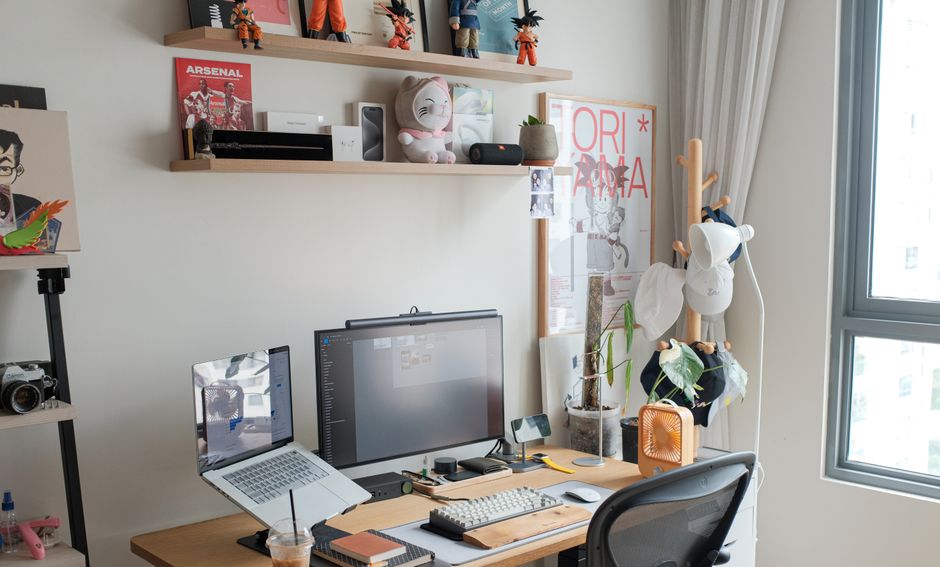
When floor space is limited, the walls become your storage plan. Floating shelves above the desk hold books, files, and supplies without eating any footprint. A pegboard turns a blank wall into flexible storage for cords, headphones, and stationery that would otherwise clutter the desktop. Wall-mounted file organizers keep paperwork upright instead of stacked in precarious piles.
The goal is to keep the desk surface itself as clear as possible — a cluttered surface makes a small room feel smaller than it is, even if the clutter is organized.
Light It Properly (Small Rooms Punish Bad Lighting)
Small spaces amplify lighting mistakes. A single overhead bulb creates flat, tiring light and harsh shadows on video calls. Layer your lighting instead:
- A task lamp with adjustable brightness, positioned to avoid glare on your screen.
- Under-shelf LED strips if your desk sits beneath shelving — they add ambient light without taking any surface space.
- Natural light from the side, not directly behind you, if you're near a window.
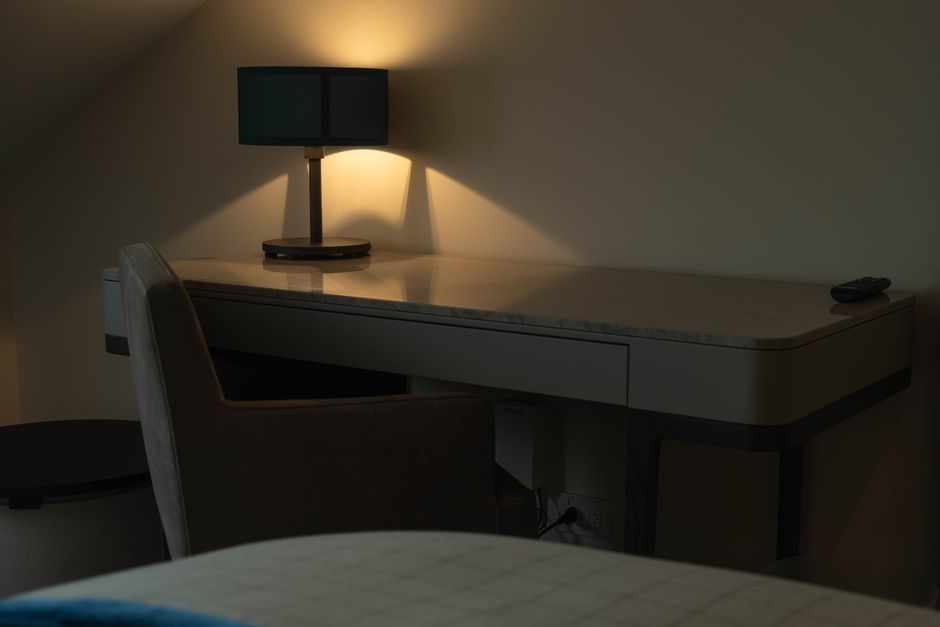
Warm-white bulbs (2700–3000K) tend to make small offices feel cozier rather than clinical, which matters when the desk is also visible from your living space.
Make It Multi-Purpose on Purpose
Most small home offices aren't dedicated rooms — they share space with a bedroom, dining area, or living room. Design for that reality instead of fighting it. A desk that doubles as a console table when closed, a chair that matches your dining set, or a cabinet that hides office supplies behind closed doors all let the space shift roles without looking like two rooms crammed into one.
Look for furniture with closed storage (drawers, cabinet doors) rather than open bins in shared spaces — it keeps work visually contained when you're not working.
Use Color and Mirrors to Open Up the Space
A small office painted the same soft, light tone as the adjoining room will visually expand rather than compete with it. If the nook has no natural light, a mirror angled to reflect a window or lamp elsewhere in the room adds brightness without adding a fixture. Avoid heavy, dark furniture in a truly tiny nook — it can be beautiful, but it will visually shrink the space more than colour ever will.
Keep Cords and Tech Contained
Nothing undoes a tidy small office faster than a nest of visible cords. A cable tray mounted under the desk, adhesive clips along the back edge, and a single power strip tucked out of sight keep the space looking calm. If your desk is against a wall, drilling a small cord-management hole through the desktop keeps cables from draping across the front where they're most visible. If you freelance from this desk, a free invoice generator keeps the paperwork as tidy as the cords.
The Takeaway
A small home office works when the layout respects the room's real constraints instead of fighting them: pick a spot near light, choose a desk shaped for the space rather than the showroom, push storage up the walls, layer your lighting, and let the space multi-task when the workday ends. Done well, a tiny office nook can feel more intentional — and more inspiring to sit down at — than a spare room ever does.
Frequently asked questions
How small can a home office space be and still work?
A functional home office can fit in as little as 15–20 square feet — think a closet, a hallway alcove, or a bedroom corner — as long as there's a stable surface, decent lighting, and enough clearance to sit comfortably.
What's the best desk depth for a tiny office nook?
For a laptop-only setup, 16–20 inches of depth is usually enough. If you use a monitor or write by hand often, aim for at least 24 inches so your screen isn't uncomfortably close.
How do I hide my home office when I'm not working?
Look for closed storage (cabinets, drawer units, a closet door), a desk that folds flat against the wall, or a room divider/curtain that visually separates the space during off-hours.
Do small home offices need overhead lighting?
Not necessarily. A well-placed task lamp and, if available, natural light from a nearby window often do more for comfort and video-call quality than a single overhead fixture.
Read next
Related articles
- Bathroom Organization Ideas That Actually Work (Even in a Small Space)
- Cozy Fall Living Room Decor Ideas (Warm and Inviting)
- Entryway Organization Ideas for a Clutter-Free Home
- Pantry Organization Ideas That Actually Last
- Easy Peel-and-Stick Backsplash Makeover (Renter-Friendly)
- DIY Board and Batten Accent Wall (Step-by-Step Guide)
Further reading & trusted sources
The part that actually matters
The mistake that ruins most tiny office nooks isn’t the desk size — it’s placing the desk so the window sits behind you, which backlights every video call and creates screen glare all day. Side-on to the window is the placement professionals default to, and it matters more than any furniture purchase.
Sofia is happiest hunting down the high-end look for a fraction of the price; she’s convinced a beautiful room comes from restraint and clever styling far more than from budget. She shapes Dreamy Dwell’s room-by-room guides around ideas you can actually copy in a rental or on a tight budget — no staged ‘this is my mansion’ fantasy. AI tools help with the research and first drafts, and a human edits every piece before it goes live. We never fake reviews or pass off a styled photo as a real before-and-after.