 By Sofia Bennett, Home & Decor Editor
Reviewed & updated September 2026
Renting means working within constraints — no painting the walls a different colour, no drilling holes in the tile, no permanent fixtures. But some of the most beautifully styled apartments belong to renters. The key is knowing which tools and tricks give you full design freedom without risking your security deposit.
 On this pageCurated by Sofia · 9 min read
- Command Strips and Removable Hardware: Your Best Friends
- Peel-and-Stick Wallpaper: A Room-Changer
- Make the Most of Rugs
- Curtains: Hang High, Hang Wide
- Furniture as the Main Event
- Lighting: Replace What You Can, Supplement the Rest
- Plants: Free Design Elements
- The Deposit-Safe Exit Checklist
- The Takeaway
- Related articles
- Further reading & trusted sources
Command Strips and Removable Hardware: Your Best Friends
Before anything else: invest in a quality set of Command strips and hooks. These pressure-adhesive products hold significant weight (some up to 7.5 lbs) and remove cleanly from most painted surfaces when pulled at the right angle.
What you can hang with Command products:
- Framed art and gallery walls
- Floating shelves (with the right bracket)
- Mirrors
- Curtain rods on window frames
- Pegboards for kitchen or office walls
The key is following the instructions exactly — surface must be clean, dry, and above 50°F; press firmly for 30 seconds; and wait the recommended time before loading weight. People who say Command strips don't work usually skipped one of those steps.
For heavier items (large mirrors, plant hangers, coat hooks), look into adhesive wall anchors rated for higher loads, or use a tension rod in a doorway or closet opening as a structural anchor.
Peel-and-Stick Wallpaper: A Room-Changer
Renter-friendly peel-and-stick wallpaper has improved enormously in recent years. The good versions (Chasing Paper, Tempaper, Walls Need Love, and several Etsy sellers) lay flat, look indistinguishable from traditional wallpaper in photos, and peel off cleanly when you leave.
Best places to use it as a renter:
- Feature wall behind the bed — an instant bedroom transformation
- Kitchen backsplash — especially useful in rentals with dated tile
- Inside bookshelves or cabinets — a small amount goes a long way
- Bathroom accent wall — measure carefully as humidity matters; choose vinyl-based options
A few things to know: peel-and-stick wallpaper is more forgiving on smooth, flat-painted walls than on textured finishes. If your walls have heavy texture, a single-color removable option or washi tape grid pattern works better than a detailed print.
Make the Most of Rugs
Renters often can't replace flooring, and many apartments have mismatched laminate or tired carpet. Rugs are the solution. A well-chosen area rug can visually "reset" a room, define a seating area, and add warmth without touching a single fixed surface.
Sizing matters more than pattern. For a living room, the rug should extend at least 6–8 inches beyond the sofa on each side, with front legs of furniture resting on it. An undersized rug (common mistake) makes the whole room feel off-balance.
Layer rugs on top of carpet for added colour and texture — this is increasingly common in interior design and looks deliberate rather than makeshift. A flat-woven or flatweave rug in a bold print on top of neutral carpet gives you pattern without commitment.
Curtains: Hang High, Hang Wide
Nothing transforms a room faster than good curtains, and renters can hang them without drilling by using:
- Tension curtain rods inside the window frame
- Command adhesive hooks at ceiling height on each side of the window
- Curtain rod brackets that rest on the window trim (no holes)
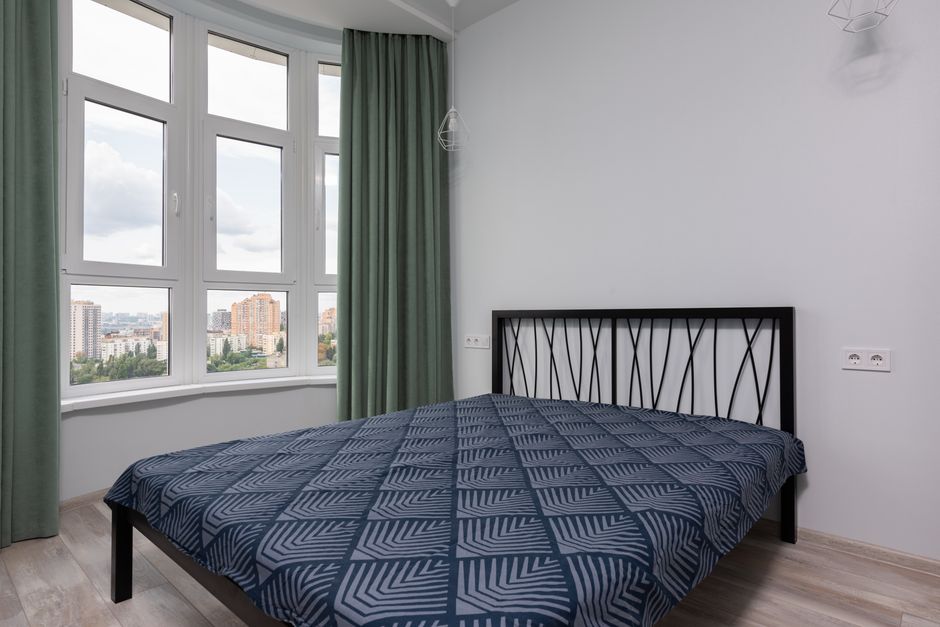
The rule that makes the biggest difference: hang curtains as close to the ceiling as possible and extend the rod 6–12 inches past the window frame on each side. This makes windows look dramatically larger and ceilings taller. Most people hang curtains too low and too narrow, and it makes the room feel cramped.
Choose fabric that pools slightly on the floor (or hits just at the floor) for a luxurious look. Lightweight linen or textured polyester are budget-friendly and rentals-safe.
Furniture as the Main Event
Since renters can't change walls, floors, or built-ins, furniture and soft furnishings are where personality lives. A few principles:
Legs matter. Furniture with visible legs — sofas, side tables, chairs — makes a room feel lighter and more spacious than pieces that sit flush with the floor. In a small apartment, this is one of the highest-impact choices you can make.
Multi-function earns its place. An ottoman with storage, a dining table that extends, a daybed that serves as both sofa and guest bed — in a rental, square footage is fixed, so every piece should work hard.
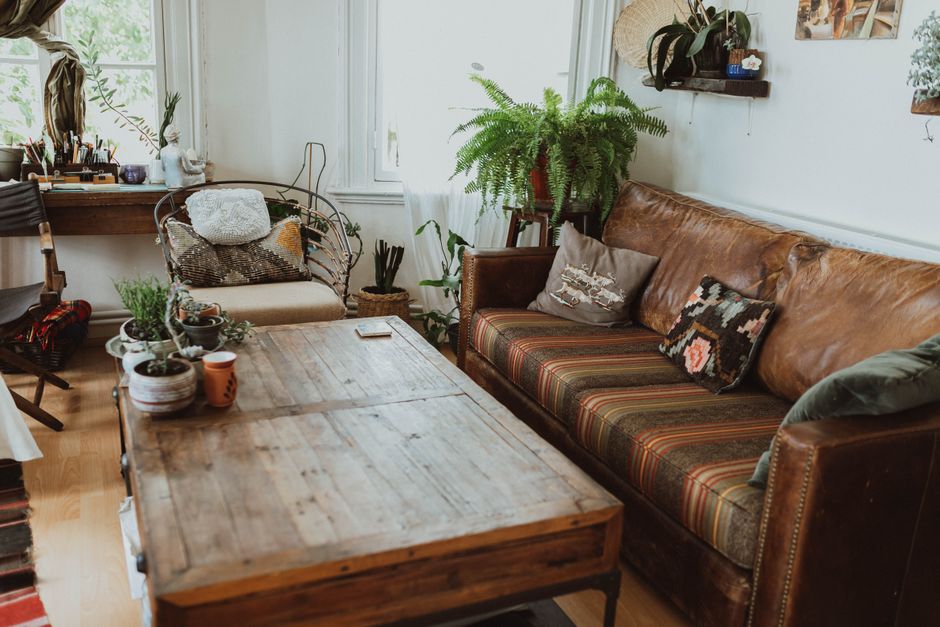
Stick to a limited palette. Rentals often have white walls, neutral carpet, and builder-grade finishes that can feel bland or pull in odd directions. A simple furniture palette of 2–3 colours (e.g., warm white + terracotta + natural wood) creates cohesion across the whole space, even in a studio.
Add height. Tall bookshelves, floor lamps, tall plants (like a fiddle-leaf fig or bamboo palm) draw the eye up and make low-ceilinged apartments feel more expansive.
Lighting: Replace What You Can, Supplement the Rest
Rental lighting is usually harsh overhead fixtures. Most are easy to swap out yourself (keep the original in a box to restore on move-out) — but even if you'd rather not, you have options.
Floor lamps immediately change the mood of a room. A warm (2700K or lower) lamp in a corner creates ambient light that makes a space feel inviting rather than clinical. Pair two floor lamps in a living room — one behind the sofa, one in a reading corner — and you may rarely turn on the overhead.
Table lamps on bookshelves or side tables layer the light and add visual interest. Mismatched lamps with matching bulb colour feel intentional and individual.
Smart bulbs in existing fixtures give you warm/cool control and dimming through an app. This is a renter's shortcut to mood lighting without touching the wiring.
Plug-in pendant lights are worth knowing about. A pendant that plugs into a standard outlet, with the cord draped over a ceiling hook (Command hook), gives you the look of hardwired pendants without a single hole.
Plants: Free Design Elements
Plants are among the most effective renter-friendly decorating tools. They add colour, texture, and life to any room, and they move with you.
A few easy-care options that work in low-light rentals:
- Pothos (nearly impossible to kill, trails beautifully)
- Snake plant / Sansevieria (thrives on neglect)
- ZZ plant (extremely low light tolerant)
- Peace lily (one of the best low-light flowering options)
Group plants in odd numbers — a set of three at different heights looks better than a single large plant or a symmetrical pair. Put them where you'd naturally look: on shelves, on a stool in a corner, trailing from a high shelf.
The Deposit-Safe Exit Checklist
Before you decorate, photograph every wall and surface when you move in. This is your baseline for any "pre-existing damage" disputes.
When you move out:
- Remove Command strips slowly, at the correct angle (peel downward)
- Fill any old nail holes from prior tenants with white toothpaste (for white walls) or proper spackle
- Restore any original light fixtures or hardware you swapped
- Clean thoroughly; a deposit-safe apartment is a clean one
The Takeaway
Renting is not a design limitation — it's a design challenge. Command adhesives, removable wallpaper, strategic rugs, high curtains, and smart lighting choices give you enormous freedom without risking your deposit. The renters whose apartments look best aren't the ones who found loopholes in their lease; they're the ones who mastered the tools that don't leave a trace.
Work with what you can't change (floors, walls, built-ins) by surrounding them with what you can: furniture, textiles, light, and living things.
Frequently Asked Questions
What's the most renter-friendly wall decor option?
Gallery walls hung with Command strips are extremely popular and effective. Use a paper template to plan the layout on the floor before committing to placement. For heavier pieces, use heavy-duty Command strips rated for the weight.
Can I use peel-and-stick wallpaper in a rental?
Yes, on smooth, painted walls. Avoid heavily textured walls, as the paper may not lay flat. Always test a small section first and leave it up for a week before papering the whole wall.
How do I make a rental apartment feel like mine without repainting?
Textiles, plants, and layered lighting do the most work quickly. Throw blankets and cushions in your chosen palette, a few statement rugs, warm lamps, and greenery can completely shift how a space feels without touching a painted surface.
Are there curtain options that don't require drilling?
Yes — tension rods inside the window frame, command hook-and-rod combinations at ceiling height, and brackets that rest on window trim all work well. The trick is hanging them high and wide to get the full visual benefit.
Read next

Related articles
- 20 Cozy Living Room Ideas on a Budget
- How to Style a Console Table (5 Easy Layouts)
- How to Choose the Right Curtains for Any Room
- Small Entryway Decorating Ideas That Still Feel Welcoming
- Living Room Lighting Ideas for a Cozy, Inviting Glow
- “Small Living Room Layout Ideas That Actually Maximize Space”
Further reading & trusted sources
Where most people go wrong
Command strips work or fail based entirely on one step: the surface must be wiped with the included alcohol pad immediately before application, not just ‘clean.’ A slightly dusty or oily wall means the adhesive bonds to the contaminant instead of the paint, and it comes down within days rather than years.
Sofia is happiest hunting down the high-end look for a fraction of the price; she’s convinced a beautiful room comes from restraint and clever styling far more than from budget. She shapes Dreamy Dwell’s room-by-room guides around ideas you can actually copy in a rental or on a tight budget — no staged ‘this is my mansion’ fantasy. AI tools help with the research and first drafts, and a human edits every piece before it goes live. We never fake reviews or pass off a styled photo as a real before-and-after.